
Emotional regulation
Name it to tame it: meaning, brain science, and scripts by age

Updated July 15, 2026
When a feeling is too big to handle, the fastest way to shrink it isn't to stop it; it's to name it. Here's the brain science behind “name it to tame it,” and the simple words you can say in the moment.
What “name it to tame it” means
“Name it to tame it” is a simple idea with a deep root: when a child is swept up in a big feeling, gently putting that feeling into words helps it lose some of its power. Instead of trying to talk a child out of an emotion, or waiting for the storm to pass on its own, you hand them language for what's happening inside: “That's frustration.” “You're really disappointed.” “Your body feels scared right now.” The phrase was coined by psychiatrist Dr. Dan Siegel and parenting expert Tina Payne Bryson in their book The Whole-Brain Child, and it has become shorthand for one of the most useful things a parent can do in a hard moment. The goal isn't to fix the feeling. It's to help your child feel understood, and, in doing so, help their brain settle.
Why putting feelings into words calms the brain
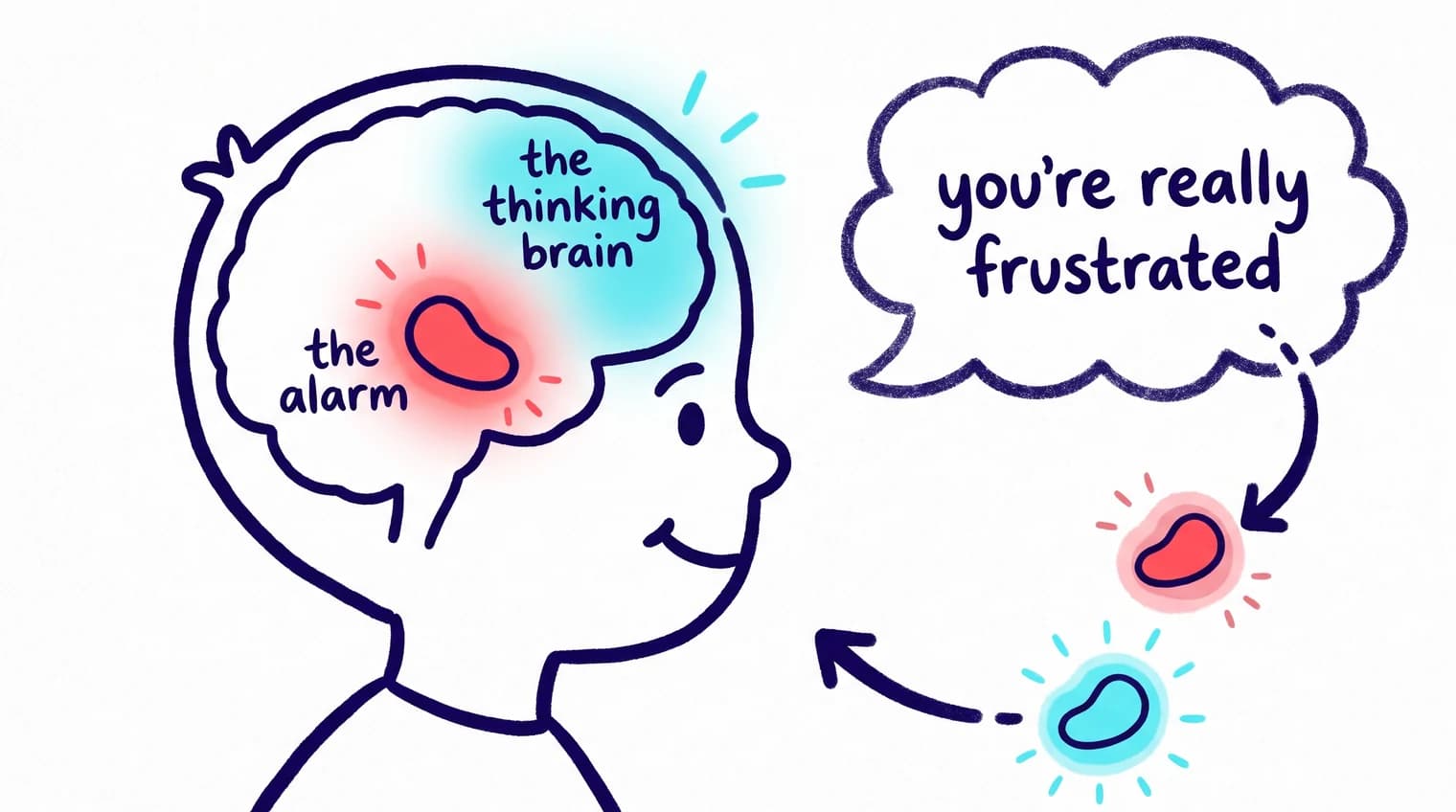
It sounds almost too simple to work. But there's real neuroscience underneath it. When a child is flooded with emotion, the brain's alarm system is running the show and the thinking brain has stepped back. Naming the feeling helps shift the balance.
Naming a feeling quiets the alarm
When we label an emotion with words, activity in the amygdala, the brain's emotional alarm center, measurably goes down. Researchers call this “affect labeling,” and it's why saying “you're so angry right now” can take the edge off a moment that talking about anything else won't.
Words bring the thinking brain back online
Language lives in the upstairs, reasoning part of the brain. Reaching for words gently invites that part back into the conversation, instead of leaving your child stuck in pure fight-or-flight. The feeling moves from something happening to them toward something they can look at.
Feeling understood is regulating in itself
Beyond the brain science, there's the relationship. When you accurately name what your child feels, they feel seen, and being understood by a calm adult is one of the most settling experiences a child can have. The naming and the connection work together.
Where this comes from
Research
Affect labeling, putting feelings into words, reduces activity in the brain's emotional alarm center, the amygdala. This is the neuroscience behind “name it to tame it.”
Lieberman et al., 2007, Psychological Science
Research
The phrase “name it to tame it” was coined as a practical strategy for helping children calm big emotions by engaging the thinking brain.
Siegel & Bryson, 2011, The Whole-Brain Child
Research
The prefrontal cortex, the brain's center for impulse control and calming strong emotions, keeps maturing into the mid-20s, which is why younger children need more help naming and managing feelings.
National Institute of Mental Health
Research
Social-emotional skills like recognizing and naming emotions can be explicitly taught, with lasting gains in behavior and wellbeing.
Durlak et al., 2011, Child Development
How to name it to tame it, by age
The technique is the same at every age (notice the feeling, give it words, stay warm) but how you say it shifts as your child grows. A few starting points.

Toddlers and preschoolers (2–5)
Keep it short and concrete, and narrate for them: “You're mad. You wanted the blue cup.” Pair the word with a gesture or a hand on the heart. At this age you're doing most of the naming, building their feelings vocabulary one moment at a time.
Early school age (6–9)
Offer the word and invite them in: “That looks like frustration. Does that feel right?” Kids this age can start to sort big feelings from small ones (“is this a little annoyed or a really angry?”), which helps them gauge intensity, not just label it.
Older kids and tweens (10+)
Hand them the wheel. Ask open questions, “what's going on in there?”, and resist supplying the answer too fast. Naming more layered feelings (“disappointed and a little embarrassed”) helps them see that more than one thing can be true at once.
At every age
Name the feeling, not the behavior, and never argue them out of it. “You're furious” lands; “there's no reason to be this upset” shuts the door. You can fully accept the feeling and still hold a firm limit on what they do with it.
Simple scripts you can say in the moment
You don't need the perfect words; warmth and an honest guess matter far more than precision. If you name it wrong, your child will usually correct you, and that's a win too. A few phrases to keep in your back pocket:
To name what you see
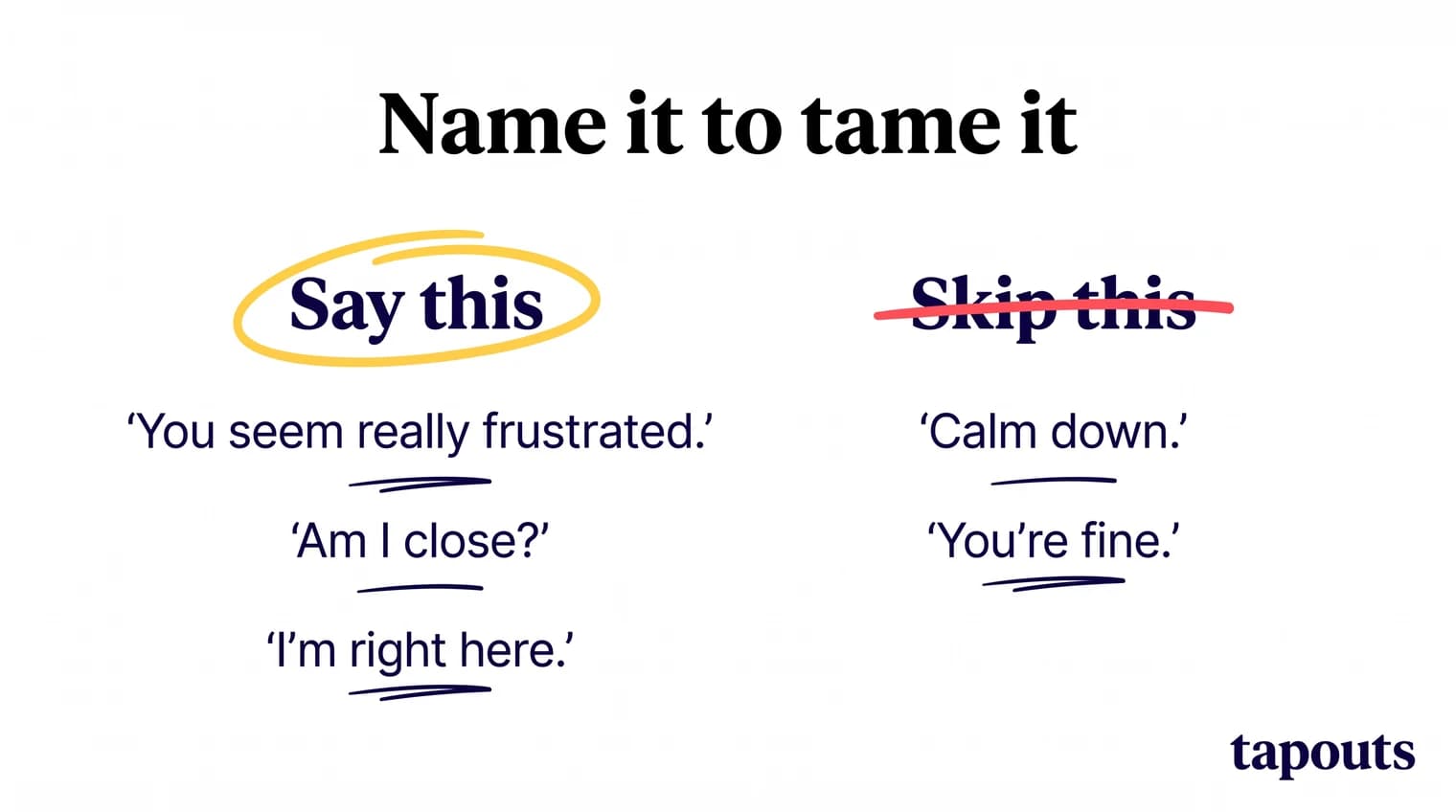
“You seem really frustrated right now.” “That was so disappointing; you were counting on it.” “Your body looks like it's feeling scared.” Naming out loud, without a lecture attached, is often the whole move.
To check your guess
“It looks like you're angry. Am I close?” “Are you more sad or more mad about this?” Offering a guess and letting them correct it hands the steering wheel back to your child.
To stay alongside the feeling
“That makes sense. I'd feel that too.” “It's okay to feel this. I'm right here.” You're showing the feeling is survivable and that you're not going anywhere while it passes.
What to skip
Step around “calm down,” “you're fine,” and “there's no reason to cry.” They tell a flooded child their experience is wrong, which tends to crank the alarm up rather than down.
A feelings-word list, by age
A feeling can only be named if the word is there to reach for. Here's a starter vocabulary, roughly by age, to keep in rotation at calm moments: over dinner, in the car, while reading. If your child is new to this, start with the big four (mad, sad, scared, happy) and grow from there.
Ages 2 to 5
- mad
- sad
- scared
- happy
- tired
- excited
- lonely
- frustrated
Ages 6 to 9
- frustrated
- disappointed
- nervous
- embarrassed
- jealous
- proud
- worried
- left out
Ages 10 and up
- overwhelmed
- anxious
- resentful
- ashamed
- torn
- relieved
- hopeful
- dread
The science, in three numbers
When the brain's self-control center finishes maturing, so younger kids need more help naming feelings
National Institute of Mental Health
Improvement in outcomes for kids in social-emotional learning programs vs. peers
Durlak et al., 2011
Students in the landmark analysis showing these skills can be taught
Durlak et al., 2011
When naming isn't enough
Naming a feeling calms a moment. It doesn't, on its own, teach a child what to do with the next one. If big feelings are turning into daily battles, meltdowns that stretch on for an hour, worries that keep your child up at night, anger that frightens them, that isn't a sign you're naming it wrong. It's usually a sign your child is ready to build the skill deliberately, with practice and coaching, the way they'd learn to swim or read. Our guides on anger management for kids and tantrums vs. meltdowns are good next steps. And if the intensity worries you, or it's getting in the way of school, friendships, or sleep, your pediatrician is the right place to start; they can help you rule out anything underneath and point you to a licensed therapist if your child needs one. If your child ever talks about hurting themselves or not wanting to be here, treat it as urgent and call or text 988 (the Suicide & Crisis Lifeline).
Help your child build a vocabulary for big feelings
Naming feelings is a skill, and like any skill, it grows with practice and gentle coaching. tapouts pairs your child with a coach and a small group where they rehearse spotting, naming, and calming big emotions, week after week, until it becomes their own.
First session free · cancel anytime
FAQs
It's a common worry, but the opposite is usually true. Putting a feeling into words tends to turn down the brain's emotional alarm rather than fan it. Naming what's happening helps a child feel understood and brings the thinking part of the brain back online, which calms the moment instead of inflaming it.
That's fine, and often useful. Offer it as a guess (“it looks like you're frustrated. Am I close?”). If you're off, your child will usually correct you, and that act of sorting it out is itself part of building emotional awareness. Warmth and a willingness to be corrected matter far more than getting it exactly right.
Yes. You can do the naming for them, out loud and low-key: “You're really angry right now, and that's okay.” There's no requirement that your child talk back. Simply hearing the feeling named by a calm adult can settle the nervous system, even in total silence.
As soon as your child has feelings, so, from toddlerhood. With very young kids you supply nearly all the words and keep them short and concrete. As children grow, you hand more of the naming over to them. The brain's self-control center keeps developing into the mid-20s, so even older kids and teens still benefit from help putting feelings into words.
Yes. Brain-imaging studies of “affect labeling” show that putting a feeling into words lowers activity in the amygdala, the brain's alarm center (Lieberman et al., 2007). And a landmark analysis of over 270,000 students found that skills like recognizing and naming emotions can be taught, with lasting gains in behavior and wellbeing (Durlak et al., 2011).
Yes. The affect labeling research was largely done with adults, so the calming effect of naming feelings doesn't expire. With teens, keep it low-key and tentative (“that sounded really frustrating”) and give them room to correct you. Many parents find that naming their own feelings out loud is regulating too, and it models the skill for their kids.
Get help with this
Anger Management for Kids
Big anger is normal, and kids can learn to manage it. Why children struggle to control anger, what's normal vs. concerning, and the science-backed skills that help. Ages 4-16.
Read more →How to Calm an Angry Child
A step-by-step, science-backed way to calm an angry child in the moment: what to do, what to avoid, and how to help the outbursts shrink over time. Ages 4-16.
Read more →Tantrums vs. Meltdowns
Tantrums and meltdowns look alike but need opposite responses. The real difference, what's happening in your child's brain, and what actually helps. Ages 4-16.
Read more →Help Your Child With Worries
Learn how to recognize when your child is struggling with worries, understand the causes, and discover proven strategies that help kids build confidence and manage big emotions. Ages 4-16.
Read more →Keep reading
Negative thinking
Catastrophizing in Kids: When Your Child Always Expects the Worst
“What if I fail?” “What if you don't come back?” “What if everyone laughs?” Why some kids' minds sprint to the worst-case ending, the scripts that interrupt the spiral, and how children learn to right-size a worry.
Read more →Emotional regulation
Childhood Meltdowns: 5 Mistakes Parents Make (and What to Do Instead)
When a meltdown hits, instinct usually makes it worse. The 5 most common mistakes parents make during a child's meltdown, and the calm responses that actually help.
Read more →Emotional regulation
Emotional Regulation by Age: What's Realistic at Each Stage
What emotional regulation really looks like from toddlers to teens. A stage-by-stage guide to calibrate your expectations to your child's developing brain.
Read more →Emotional regulation
What Is Co-Regulation? And Why Your Child Needs It First
Co-regulation is how kids borrow a calm adult's nervous system before they can calm themselves. What it is, real examples, and how it grows into self-regulation.
Read more →Every child deserves to feel confident
Join 20,000+ families helping their kids build emotional strength. Your child's first session is free.
First session free · cancel anytime