
Negative thinking
Catastrophizing in Kids: When Your Child Always Expects the Worst

Updated August 24, 2026
One small worry, and their mind sprints to the end of the world: a missed goal becomes “I'll be cut from the team,” a cough becomes “what if I'm really sick?” Catastrophizing is one of the most common thought traps in childhood, and one of the most coachable. Here's how the spiral works and how to interrupt it.
What catastrophizing actually is
Catastrophizing is the mind's habit of treating the worst possible outcome as the most likely one. In kids it usually runs as a chain of “what ifs,” each link a little darker: “what if I get the answer wrong” becomes “what if everyone laughs” becomes “what if I have no friends.” Two things make children especially prone to it. First, estimating probability is a genuinely late-developing skill; to a nine-year-old, “possible” and “probable” feel like the same thing, so a one-percent risk carries hundred-percent dread. Second, anxiety narrows attention onto threat, so once the alarm is on, the mind generates worst cases the way a popcorn machine generates popcorn. It matters because the body can't tell the difference between an imagined catastrophe and a real one: a child picturing the worst is having a real stress response to a fictional event, sometimes many times a day. The goal isn't to stop worries from arriving; it's to teach a child to catch the spiral and right-size it.
What the spiral looks like day to day
Catastrophizing rarely announces itself as “I am imagining the worst case.” It hides inside ordinary moments:
The bedtime “what if” parade
The lights go out and the questions start: what if there's a fire, what if you get sick, what if I forget my lines. Nighttime is prime spiral time because there's nothing else competing for attention, and a tired brain is worse at right-sizing.
Avoidance dressed as “I don't want to”
A child who refuses the sleepover, the tryout, or the class presentation often isn't uninterested; they've already run the disaster movie and decided not to buy a ticket. When the imagined ending is humiliation, not trying feels like the only safe move.
Big reactions to small setbacks
Tears over one wrong answer, panic over a forgotten lunchbox. The reaction fits the imagined ending (“I'll fail the class,” “I'll starve”), not the actual event. If your child's response regularly seems three sizes too big, catastrophizing is often the multiplier.
Reassurance that never sticks
You answer the “what if,” they feel better for a minute, and the same question returns. That loop is the signature of catastrophic worry: reassurance treats the question, not the habit, so the habit keeps generating questions.

How to interrupt the spiral: scripts that work
You can't argue a child out of a catastrophe any more than you can argue them out of a nightmare. What works is teaching them to examine the prediction like a scientist rather than obey it like a prophecy. A few tools, best taught in calm moments and used in hard ones:
Name the trap first
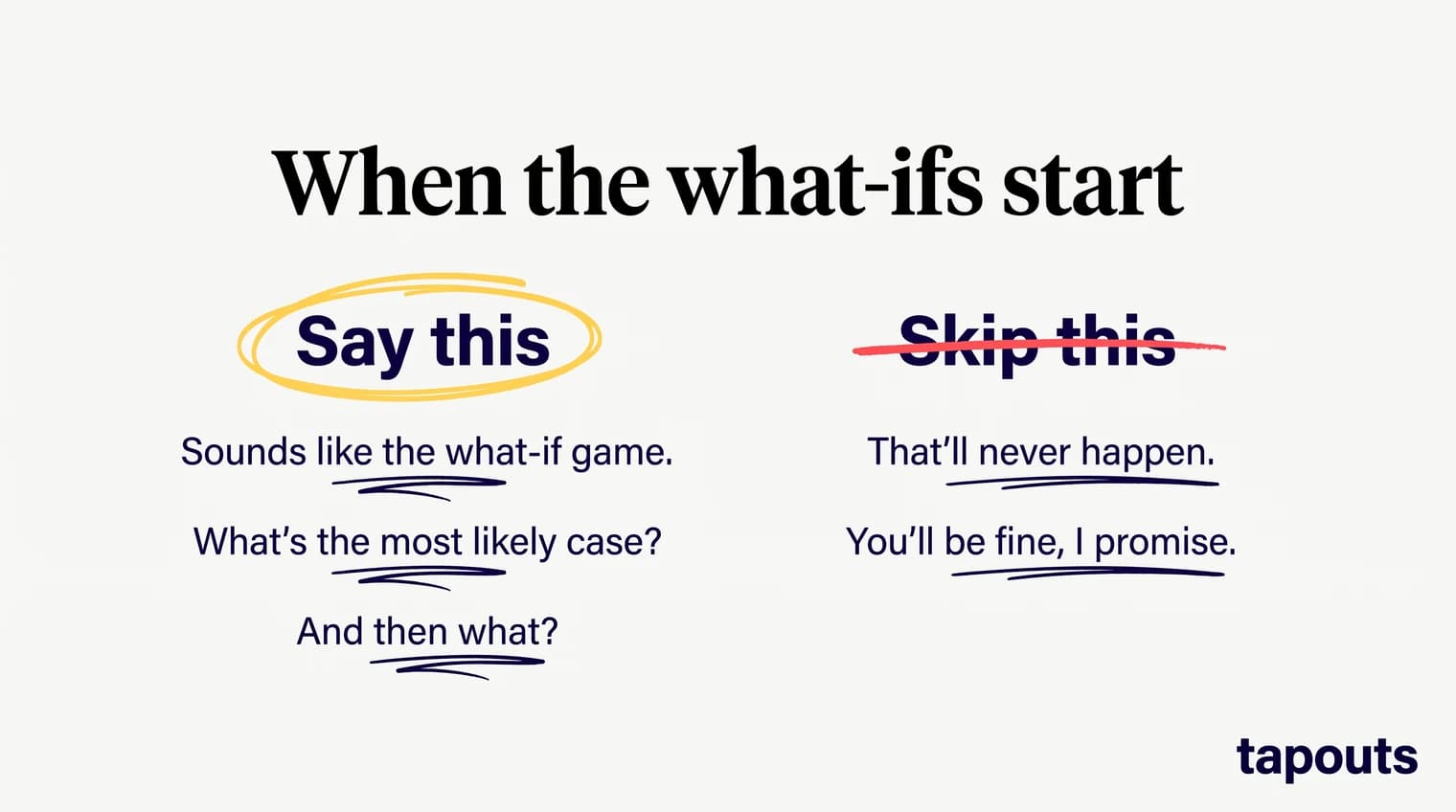
“Sounds like your brain is playing the what-if game again.” Naming the pattern (not arguing with the content) gives your child distance from it. Many families give the spiral itself a nickname, which turns “I'm doomed” into “oh, that's Worst-Case World talking.”
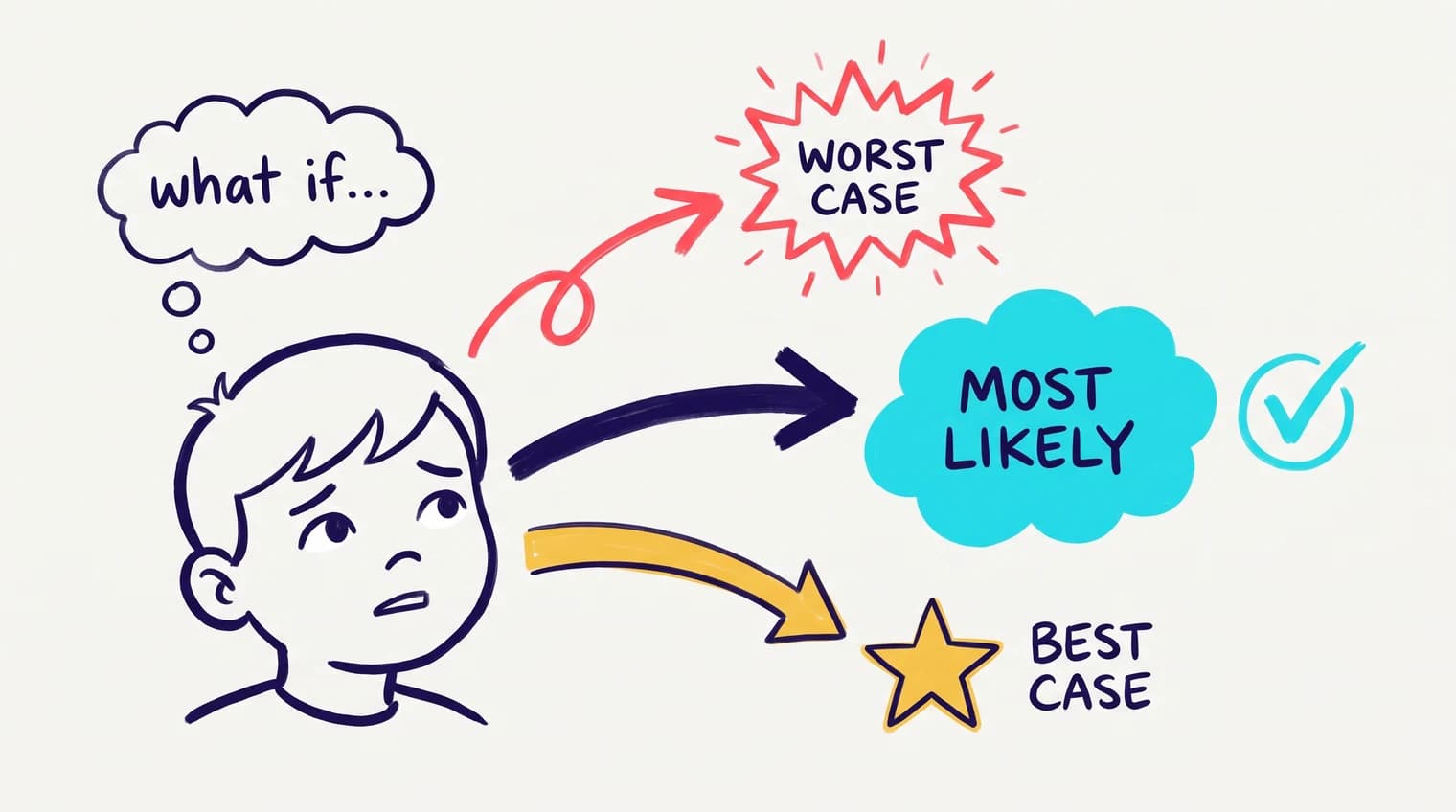
Best case, worst case, most-likely case
The classic de-catastrophizing move, and kids take to it fast. “Okay, worst case: you forget your lines and everyone laughs. Best case: you're perfect. Now the real question: what's the MOST LIKELY case?” Most kids can find the middle on their own, and finding it themselves is what builds the skill.
“Has it happened before?”
Catastrophic predictions have terrible track records, and kids can learn to check them. “Your brain says you'll have no one to sit with. How did lunch actually go the last ten times?” Evidence beats argument, especially their own evidence.
“And then what?”
Gently walk past the feared ending instead of stopping at it: “Say you DO get the answer wrong. And then what?” Kids usually discover the story continues (“I'd feel embarrassed for a bit... then class would move on”), and a survivable catastrophe stops being a catastrophe.
Answer the feeling, ration the reassurance
Endless reassurance feeds the loop. Instead: validate once (“that's a scary thought”), answer once, then hand the tool back: “what would you tell that worry?” If bedtime is the hot spot, a “worry time” earlier in the evening (ten minutes to say every what-if out loud, then park them) keeps the parade off the pillow.
Help your child become the boss of the what-ifs
Catching a thought spiral and right-sizing it is a skill, and skills stick through practice. In tapouts small-group coaching, kids rehearse exactly these moves every week with a coach and peers who are learning them too, so the tools are ready before the next spiral starts.
First session free · cancel anytime
When catastrophizing needs more than coaching
Every child catastrophizes sometimes; the habit responds well to the tools above practiced patiently. It deserves professional attention when the worry is most days rather than occasional, when it's driving real avoidance (school refusal, dropped activities, shrinking friendships), when sleep is regularly lost to it, or when physical symptoms (stomachaches, headaches) cluster around the fears. Persistent, life-narrowing worry can be a sign of an anxiety disorder, which is common in children and responds very well to treatment; cognitive behavioral therapy teaches exactly these de-catastrophizing skills in a clinical setting. Talk to your pediatrician or a child therapist as a first step. And one honest note: tapouts is coaching, not therapy. We help kids build thinking skills; when worry is clinical, coaching complements professional care and never replaces it. If your child ever expresses hopelessness or mentions self-harm, seek help right away: call or text 988 (the Suicide & Crisis Lifeline).
Where this comes from
Research
Teaching children to identify, evaluate, and dispute overly negative predictions reduces depressive and anxious symptoms, with effects lasting beyond the program.
Brunwasser, S. M., Gillham, J. E., & Kim, E. S. (2009). Journal of Consulting and Clinical Psychology, 77(6)
Research
Anxiety disorders are among the most common mental health conditions in children and adolescents, and evidence-based treatments such as cognitive behavioral therapy are effective.
National Institute of Mental Health (NIMH)
Research
Putting feelings and fears into words reduces activity in the brain's threat system, which is why naming the spiral is itself a calming move.
Lieberman, M. D. et al. (2007). Psychological Science, 18(5)
Research
Guidance for parents on responding to children's anxious 'what if' thinking, including validating without over-reassuring and helping kids test their predictions.
Child Mind Institute
FAQs
It's usually a thought habit called catastrophizing, and kids are especially prone to it: judging how LIKELY something is develops late, so a possible disaster feels like a probable one, and anxiety narrows attention onto threat. It shows up as chains of “what if” questions, big reactions to small setbacks, and avoidance of anything with an imaginable bad ending. It's one of the most coachable thinking patterns there is.
Don't argue with the content; teach them to examine the prediction. Name the pattern (“the what-if game again”), then run best case / worst case / most-likely case, check the track record (“has that ever actually happened?”), or walk past the feared ending (“and then what?”). Validate the feeling once, answer once, and resist reassuring on repeat, because endless reassurance feeds the loop rather than ending it.
Not by itself; every child imagines worst cases sometimes. It points toward an anxiety disorder when it happens most days, drives real avoidance (school, activities, friends), regularly costs sleep, or comes with clustering physical complaints like stomachaches. Childhood anxiety is very treatable, and cognitive behavioral therapy teaches exactly these skills clinically. Your pediatrician or a child therapist is the right first stop, and if your child ever mentions self-harm or hopelessness, call or text 988 right away.
Reassure once, warmly, and then shift from answering the worry to coaching the skill. If you answer the same “what if” ten times, the worry learns that asking works and comes back for more. “That's a scary thought. What would you tell it?” hands the job back. For bedtime spirals, a short scheduled “worry time” earlier in the evening keeps the what-ifs from owning the pillow.
Get help with this
Negative Thinking in Children
“I'm stupid.” “Nobody likes me.” “I always mess up.” A calm, science-backed guide to negative thinking in children: where it comes from, how to respond in the moment, and the skills that turn the inner critic into an inner coach. Ages 4-16.
Read more →Help Your Child With Worries
Learn how to recognize when your child is struggling with worries, understand the causes, and discover proven strategies that help kids build confidence and manage big emotions. Ages 4-16.
Read more →Keep reading
Negative thinking
Negative Self-Talk in Children: What to Say When Your Kid Is Hard on Themselves
“I'm stupid.” “I can't do anything right.” Why kids talk about themselves this way, exactly what to say in the moment (and what makes it worse), and how children learn to talk back to their inner critic.
Read more →Anxiety & worries
Is My Child's Worry Normal?
Every kid worries, so how do you know when it's too much? A clear guide to normal childhood worry vs. an anxiety problem, the signs that matter, and what to do at each level.
Read more →Emotional regulation
Name it to tame it: meaning, brain science, and scripts by age
“Name it to tame it,” from Dr. Dan Siegel's The Whole-Brain Child, means labeling a feeling to calm it. What the phrase really means, the brain science behind it, and word-for-word scripts for toddlers through teens.
Read more →Anxiety & worries
When Your Child Is Afraid of the Dark
Fear of the dark is one of the most common childhood fears, usually most intense between ages 3 and 8. What age it typically starts, why it happens, whether it's normal, and calm, practical ways to help your child feel safe at night.
Read more →Every child deserves to feel confident
Join 20,000+ families helping their kids build emotional strength. Your child's first session is free.
First session free · cancel anytime